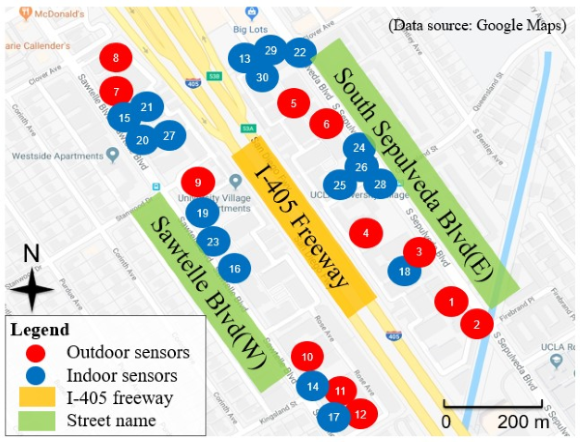
Attempts to collect real-time and high-resolution air quality data have been encumbered by the limitations of expensive air monitoring devices. The emergence of low-cost, user friendly air quality sensors (e.g., PurpleAir sensors) enables observations at high spatial resolution and provide temporal air pollution data in real-time. However, there is no generally accepted evidence on the long-term performance of the commercially available air quality sensors and their applications in the real world. Therefore, our study aims to evaluate the long-term performance and explore the real-world application of the low-cost air sensors deployed in a community for both indoor and outdoor environments. For example, to better understand the human exposure to traffic-related air pollutants at a community level, we explore the temporal characteristic and the spatial variability of PM in a community adjacent to an interstate highway using the low-cost sensor network.
Publications:
Fanyu Zhang. “Monitoring Indoor Air Quality Using Low-cost Sensors at a Community Scale” [master’s thesis].Los Angeles (CA): University of California, Los Angeles, 2019, https://escholarship.org/uc/item/2h03q3kw.