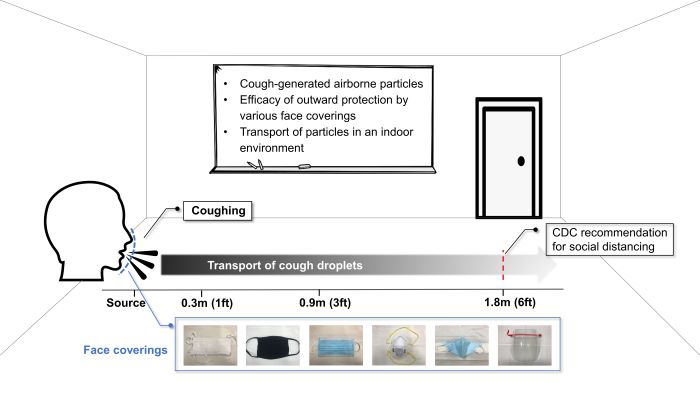
Exposure to respiratory droplets contributes greatly to the spread of SARS-CoV-2 virus during the COVID-19 pandemic. Since both symptomatic and asymptomatic carriers can be potential infection sources, the outward protection provided by face coverings to mitigate the spread of respiratory droplets is particularly important. We aim to evaluate the effectiveness of using various face coverings against the outward transport of respiratory droplets at multiple locations in an indoor environment.
AAAR 2020 Conference Presentation:
Assessing the Effectiveness of Using Face Coverings to Mitigate the Transport of Particles Generated from Coughing
October 2020
Publications:
Liqiao Li, Muchuan Niu, and Yifang Zhu, “Assessing the effectiveness of using various face coverings to mitigate the transport of airborne particles produced by coughing indoors”, 2020, Aerosol Science and Technology, https://doi.org/10.1080/02786826.2020.1846679
Project 2:
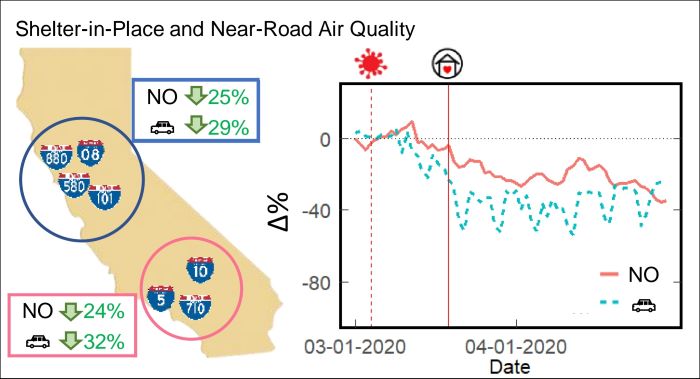
The COVID-19 pandemic and resulting shelter-in-place measures led to widespread adoption of remote work policies and temporary business closures or operation curtailments, disrupting typical commuting patterns. We investigated the impacts of the shelter-in-place order during March and April 2020 on near-road traffic and air quality in California. Our findings demonstrated that reduced vehicle activity significantly improved air quality, contributing to the body of evidence linking shelter-in-place measures and cleaner air.
Publications:
Jonathan Liu, Jonah Lipsitt, Michael Jerrett, and Yifang Zhu. “Decreases in Near-Road NO and NO2 Concentrations during the COVID-19 Pandemic in California.” Environmental Science & Technology Letters. https://doi.org/10.1021/acs.estlett.0c00815.
Project 3:
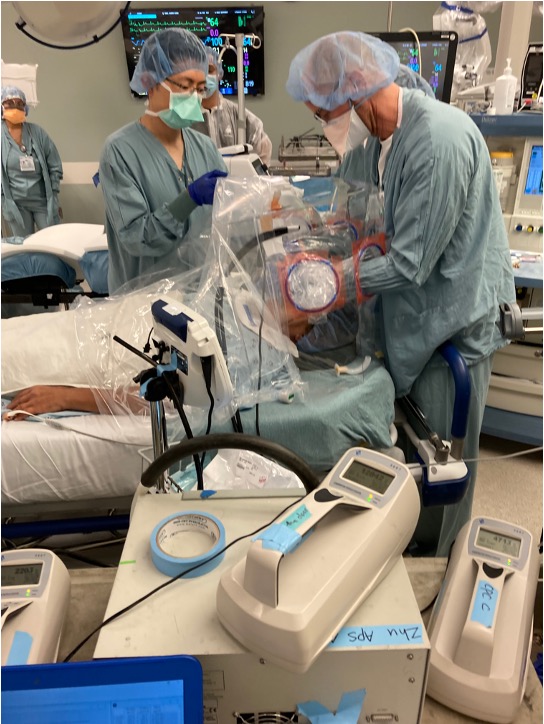
The COVID-19 pandemic has created new challenges to health care workers (HCWs) when doing airway managements. Anesthetists are thus especially at high risks as they are directly exposed to the respiratory particles exhaled by the patient during tracheal intubation. Therefore, a functional and effective personal containment device (PDC) is key to their work safety. We have designed a suction-assisted local aerosol containment chamber (SLACC) to protect against viral-laden respiratory particle exposure for HCWs. We aim to evaluate the containment capability of the device in real operation room (OR) settings with patients (n=79). We expect to see significant reductions in particle numbers outside the box compared to no box condition, indicating good particle containment capability of the device. This is a joint project with the Department of Anesthesiology, UCLA David Geffen School of Medicine.